Hardware Product Discovery Services

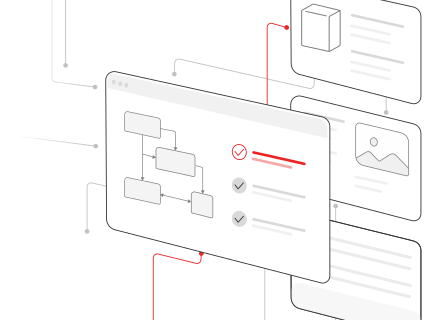
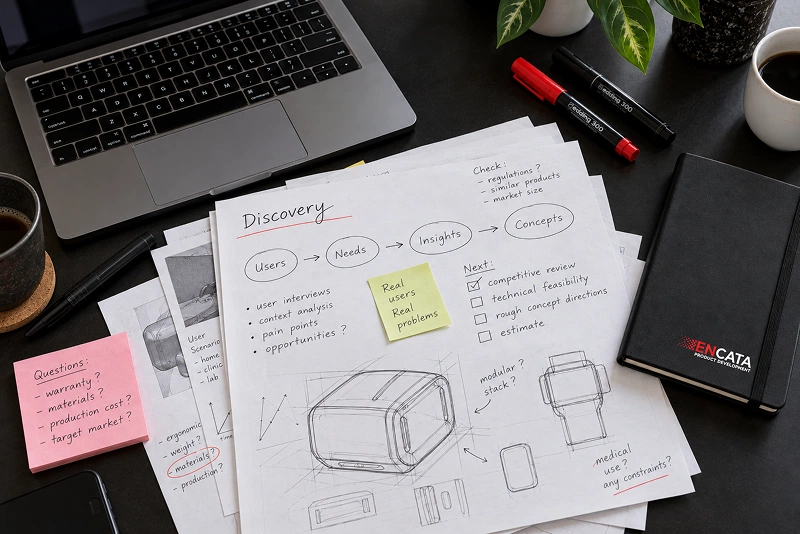
In a focused 100-hour scope, we turn your product idea into a clear engineering brief, structuring user scenarios, prioritizing and quantifying functions, listing constraints, creating mockups when needed, benchmarking solutions, and defining the next validations for the Feasibility phase.

100-hour starting point
Quantified future-device functions
Concepts aligned with required standards
When You Need Product Discovery Services by EnCata

When you need Discovery shaped for Feasibility

We approach Discovery with the next validation stage in mind. Before checking whether the product can be built, we help define what exactly should be checked: user scenarios, key functions, business constraints, technical assumptions, and open questions.

When you need concepts grounded in engineering reality

AI tools and internal brainstorming can produce convincing concepts that hide excessive cost, complexity, or unrealistic technical logic. We help shape product directions that make sense not only visually, but also technically and economically.

When you need an honest early-stage opinion

Not every concept should move straight into Feasibility, PoC, or Prototype. If the idea is overbuilt, technically weak, or misaligned with your business goal, we say it early and help simplify, redirect, or stop before more budget is spent.

Product development phases

EnCata supports products from Feasibility Study through Low Volume Manufacturing.

1

Product Discovery

A structured research phase that turns an initial idea into a clear product direction. We define the problem, target users, business goals, key requirements, risks, constraints, and development priorities before moving into technical validation.

GOAL
Define product vision, scope, and value proposition
Deliverables
Product vision, stakeholder and user insights, requirements, risk assessment, initial roadmap
2

Feasibility Study

A technical and business validation phase that determines whether the proposed product can be realistically built, scaled, and produced within target cost, performance, and manufacturing constraints. We compare possible architectures, identify risks, estimate key costs, and recommend the most viable development path.

GOAL
Confirm technical approach and validate the business case
Deliverables
Feasibility report, technology assessment, architecture comparison, BOM and cost estimate, recommended development path
3

Proof of Concept

A focused physical setup that tests whether the core technical principle can work in practice. At this stage, we isolate the critical assumption, use only the components and engineering effort needed for validation, and collect measurable evidence before moving to prototype development.

GOAL
Validate core technical feasibility with minimal resources
Deliverables
PoC question framing, bench-level setup or test rig, test results and observations, technical conclusion, recommended next steps
4

Prototype

A functional product version used to test how all key units, components, and systems work together in conditions close to real use. At this stage, the product includes core features, a more detailed design and components than a PoC, while the enclosure and final production setup may still be refined.

GOAL
Validate functionality, refine engineering solutions, and collect early user feedback.
Deliverables
Functional prototype, integrated components, preliminary enclosure, test results, improvement recommendations.
5

MVP

A functional engineering device that integrates the core electronics, firmware, enclosure, and mechanical elements into a demonstrable product. At this stage, the team moves beyond isolated prototypes and prepares the solution for investor presentations, early user validation, field or laboratory testing, and pilot discussions.

GOAL
Build an integrated MVP that proves the product’s core value in real use conditions
Deliverables
Functional MVP device, optimized BOM, CAD files, PCB design files, firmware, assembly documentation, test findings, and recommendations for pilot manufacturing and DFM optimization.
6

Pilot Batch

A limited production run that checks whether the MVP can be manufactured consistently across multiple units. At this stage, we validate the assembly process, tooling, testing, quality control, yield, packaging, and readiness for the next manufacturing stage.

GOAL
Validate repeatable manufacturing before scaling production
Deliverables
Pilot readiness review, production-intent units, tooling and fixtures, test setup, assembly feedback, test results, defect findings, packaging notes, DFM recommendations, and a plan for low-volume or larger-scale production.

Product development phases

EnCata supports products from Feasibility Study through Low Volume Manufacturing.

Product Discovery

A structured investigation into whether the proposed solution is technically and commercially viable. We identify critical risks early and define the right technical approach before committing significant resources.

GOAL
Confirm technical approach and validate the business case
Deliverables
Feasibility report, technology assessment, recommended development path

Feasibility Study

A technical and business validation phase that determines whether the proposed product can be realistically built, scaled, and produced within target cost, performance, and manufacturing constraints. We compare possible architectures, identify risks, estimate key costs, and recommend the most viable development path.

GOAL
Confirm technical approach and validate the business case
Deliverables
Feasibility report, technology assessment, architecture comparison, BOM and cost estimate, recommended development path

Proof of Concept

A focused physical setup that tests whether the core technical principle can work in practice. At this stage, we isolate the critical assumption, use only the components and engineering effort needed for validation, and collect measurable evidence before moving to prototype development.

GOAL
Validate core technical feasibility with minimal resources
Deliverables
PoC question framing, bench-level setup or test rig, test results and observations, technical conclusion, recommended next steps

Prototype

A functional product version used to test how all key units, components, and systems work together in conditions close to real use. At this stage, the product includes core features, a more detailed design and components than a PoC, while the enclosure and final production setup may still be refined.

GOAL
Validate functionality, refine engineering solutions, and collect early user feedback.
Deliverables
Functional prototype, integrated components, preliminary enclosure, test results, improvement recommendations.

MVP

A functional engineering device that integrates the core electronics, firmware, enclosure, and mechanical elements into a demonstrable product. At this stage, the team moves beyond isolated prototypes and prepares the solution for investor presentations, early user validation, field or laboratory testing, and pilot discussions.

GOAL
Build an integrated MVP that proves the product’s core value in real use conditions
Deliverables
Functional MVP device, optimized BOM, CAD files, PCB design files, firmware, assembly documentation, test findings, and recommendations for pilot manufacturing and DFM optimization.

Pilot Batch

A limited production run that checks whether the MVP can be manufactured consistently across multiple units. At this stage, we validate the assembly process, tooling, testing, quality control, yield, packaging, and readiness for the next manufacturing stage.

GOAL
Validate repeatable manufacturing before scaling production
Deliverables
Pilot readiness review, production-intent units, tooling and fixtures, test setup, assembly feedback, test results, defect findings, packaging notes, DFM recommendations, and a plan for low-volume or larger-scale production.

Need a Team That Can Structure Your Hardware Idea?

Schedule a call with us to discuss your product idea. We’ll review your current inputs, and explain how our team can turn them into a clear Feasibility or PoC scope.

Start Discovery

Our Approach to Hardware Product Discovery

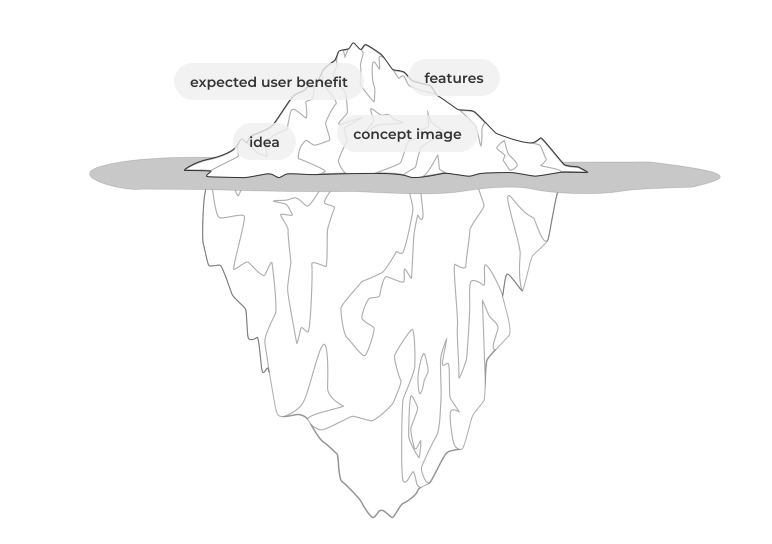
Through hundreds of projects, we’ve learned that Discovery should not be limited to writing down what the customer says. A good Discovery shows what the idea requires, what the inputs may trigger, and what should be checked next.

Business context first

If you don’t want engineers designing around assumptions that miss the business goal, we’ll start by defining the problem, target users, product value, and success criteria your business aims to achieve.

Technical benchmarking

Instead of a marketing-level competitor overview, you get benchmarking that supports engineering decisions: functions, performance, cost logic, components, size, materials, and limitations.

Hidden requirement mapping

Small omissions often become expensive later. We map supporting functions, interfaces, operating environment, standards, component logic, and constraints that may not be obvious from the initial idea.

Feasibility view built in

We approach Discovery with Feasibility in mind. While reviewing the concept, we already look at what seems realistic, what may create technical or economic risks, what should be simplified, and what requires deeper validation at the next stage.

Why EnCata

01

Fixed 100-hour starting point

You do not enter an open-ended consulting process. In about 100 hours, we structure your product idea, clarify key assumptions, involve engineering expertise, and define what should happen next.

02

Consequence mapping

We don’t take every initial requirement as fixed. Some inputs may quietly create technical limits, cost growth, or development complexity. We review them with you early, explain the trade-offs, and help separate what is essential from what can be adjusted.

03

Grounded product concept

Unlike an AI-generated render or a brainstorm summary, you do not receive a pile of untested ideas. When needed, we create quick mockups to visualize the concept, discuss it with you, and spot weak points before the project moves to Feasibility or prototyping.

04

Early IP risk check

You get an early, directional check of patent-related risk before the concept moves into Feasibility or development. We flag potentially sensitive technical directions, so you can adjust the concept before investing in a solution that may conflict with existing IP.

Expert Insight

What Defines Discovery in Hardware Products

Software discovery can start with screens, flows, and user stories. Hardware discovery also has to deal with physical reality.

A physical product cannot be changed every day after release, so early assumptions matter more.

Most teams begin with what is visible. But hardware also depends on what is not obvious yet.

Operating conditions

A feature may look simple until it meets heat, dust, moisture, vibration, sunlight, cleaning, transportation, or outdoor use.

Measurable functions

Hardware requirements cannot stay vague. “Compact”, “quiet”, “fast”, or “accurate” must become target size, runtime, noise level, speed, capacity, force, or precision.

Supporting systems

Every visible function needs hidden systems behind it: power, sensors, firmware, storage, connectivity, cooling, mounting, safety, or assembly logic.

Expert Insight

Featured Projects

Work that highlights the incredible technologies, solutions, and products EnCata developed

View all portfolio
Consumer & wearable

Custom Smart Beverage Pourer

EnCata supported a startup as an engineering contractor, developing a smart beverage pourer for bars that meters each pour in real time, connects to POS and mobile apps, and enables NFC payments — from PoC to MVP. All IP belongs to the customer.

up to 50%

increase in bar revenue

250% faster payments

via credit cards and NFC-enabled transactions

View Project
Consumer & wearable

Custom Smart Kitchen Kettle

EnCata developed a smart kitchen appliance for a European company entering the smart home market. We delivered feasibility studies, electronics, firmware, and a working prototype for a device that brews coffee, tea, and prepares baby formula.

1.5 min

to cool water from 100 °C to 38 °C

4 patents

filed during development

View Project
Agriculture

Hydroponics IoT Plant Pot

EnCata engineered a smart hydroponics IoT plant pot that automates plant care through nutrient dosing, using sensors and cloud control. We delivered industrial design, CAD models, BOM, and specs to help the client move from lab research to a market-ready device.

4

concepts developed as part of this project

9

major modules to enable functionality

View Project
IIoT & automation

AI-driven tools tracking system

EnCata engineered an AI-powered tool tracking system which combines 5S boards with machine vision to monitor tool usage in real time. Integrated with ERP/CRM software, it improves accountability and reduces losses. Our team took the project from concept through to a working IIoT solution.

5 months

project duration

2,000 mm

max width of the 5S board

View Project
Other

Sludge Recycling Feasibility Study

EnCata delivered a sludge recycling feasibility study in Oman, assessing six treatment technologies and CAPEX. The study shaped the plan for a waste disposal plant with 100 tons/day sludge capacity, providing the client with clear technical and business guidance.

6

technologies considered in this feasibility study

405 MMBTU

annual energy savings at 100-ton/day sludge capacity

View Project
0
0

Still Not Sure EnCata Is the Right Partner?

Leave your contact details. We’ll explain how Discovery with EnCata works, what deliverables you receive, which cooperation model fits your stage, and how we identify hidden concept constraints before they turn into costly engineering work.

Talk to EnCata
Expert Insight

What’s Included in Hardware Product Discovery

We organize early product input into a PRD-like Discovery package for the next technical stages: structured enough to estimate, validate, and turn into Feasibility, PoC, or Prototype tasks.

Function breakdown

User scenarios are translated into must-have and optional functions, including supporting systems that are required behind the visible product features.

Next-stage brief

The output includes assumptions, open questions, benchmarking notes, early standards/IP flags, and validation tasks for Feasibility, PoC, or Prototype – not a confirmed feasibility conclusion.

Concept options

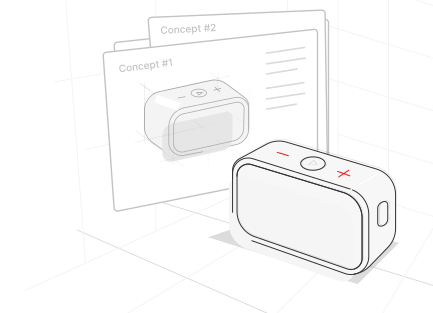
You receive possible product directions with form-factor logic, interfaces, subsystem assumptions, operating conditions, and simple mockups or visuals when needed.

Discovery intake

Your idea, sketches, AI outputs, competitor references, business goals, and existing materials are structured into one starting brief, with unclear inputs marked for discussion.

Meet EnCata Team

Product Discovery at EnCata is handled by a cross-functional hardware team that works in sync as a single organism and provides a second opinion to make sure your concept is solid.

45+
team
6
architects
120+
projects started from discovery
Industries

We Design Across Various Industries

Deep domain understanding increases the success rate of your product.

Consumer & wearable

Consumer & wearable

96
projects delivered

Our team specializes in full-cycle consumer electronics and wearables development and manufacturing. Explore the page to see relevant project examples.

See how we deliver
IIoT & automation

Industrial IoT (IIoT) and Automation Hardware Solutions

15
projects delivered

EnCata will automate your production facility or warehouse with sensors, actuators, and edge computing, providing real-time data processing and efficiency.

See how we deliver
Industrial equipment & tools

Custom Industrial Equipment & Tools

243
projects delivered

Can’t find the right equipment? Discover how EnCata’s custom-built solutions tackle your unique challenges and enhance your production efficiency.

See how we deliver
Analytical & lab equipment

New Analytical & Laboratory Equipment Development

12
projects delivered

Explore EnCata’s custom solutions for analytical and lab equipment. Discover our precision design and development services—click to enhance your lab today!

See how we deliver
Agriculture

Custom Agricultural Hardware Solutions

8
projects delivered

EnCata helps bring your new tech in agriculture to life, including precision agriculture and robotic farming, turning your innovative ideas into reality.

See how we deliver
Green tech

Green Tech

projects delivered

This page is still under development. If you're interested in our experience in this field, please fill out the contact form and we’ll get back to you.

See how we deliver
Healthcare

Healthcare

23
projects delivered

Expertly developed, tested, and manufactured devices ready for market entry. We guide your product through all stages to market. Go test our expertise!

See how we deliver
Robotics

Robotics Solutions for Cutting-Edge Automation

6
projects delivered

Custom robotics solutions for automation—robotic arms, AGVs, and more. Contact us to develop tailored robotics systems for your business needs.

See how we deliver
Smart city

Smart City

projects delivered

This page is still under development. If you're interested in our experience in this field, please fill out the contact form and we’ll get back to you.

See how we deliver
Food tech

Custom Hardware Solutions for Food and Drinks

6
projects delivered

We develop custom solutions for food and drinks: from dosing and filling systems to quality control, and automated cooking systems. Contact us today!

See how we deliver
Vehicles

Vehicles

projects delivered

This page is still under development. If you're interested in our experience in this field, please fill out the contact form and we’ll get back to you.

See how we deliver
Other

Other

projects delivered

This page is still under development. If you're interested in our experience in this field, please fill out the contact form and we’ll get back to you.

See how we deliver
FAQs

Frequently Asked Questions

Have a question that needs a human to answer? No problem.

Speak to our Sales Team now
What is the difference between Discovery and Feasibility Study?
What do I receive after Discovery?
Do I need technical requirements before Discovery?
Can EnCata review an AI-generated product concept?
Can Discovery help reduce future development cost?
What happens after Discovery?